
Leggi questa pagina in italiano
Curated by Gabriele Landi (Source: Parola d’artista, 2023)
Gabriele Landi: Hi Giovanni, how important is the matter/space relationship in your work?
Giovanni Longo: Hi Gabriele. In my research, the origin of the material is a conceptual matrix. Fitting in a natural process, in the action of the current’s force unleashed on these shrubs, uprooting them and dragging them ashore, subverting their shape and colour, is not about mere recovery but, rather, an interference. It is almost as if a dam deviated from this matter stream by swerving it elsewhere, be it an exhibition venue, a gallery or a museum. I preserve the shapes crafted by nature, classify them, archive them and use them to create these structures where individual pieces play a leading role in achieving this evasion.
The spaces of interaction so become two: one where the collection takes place and one to complete the process, which brings these elements to deprivation of time by becoming poetic devices or, at least, trying to be.
G. Landi: How do these devices interact with the space that accommodates them?
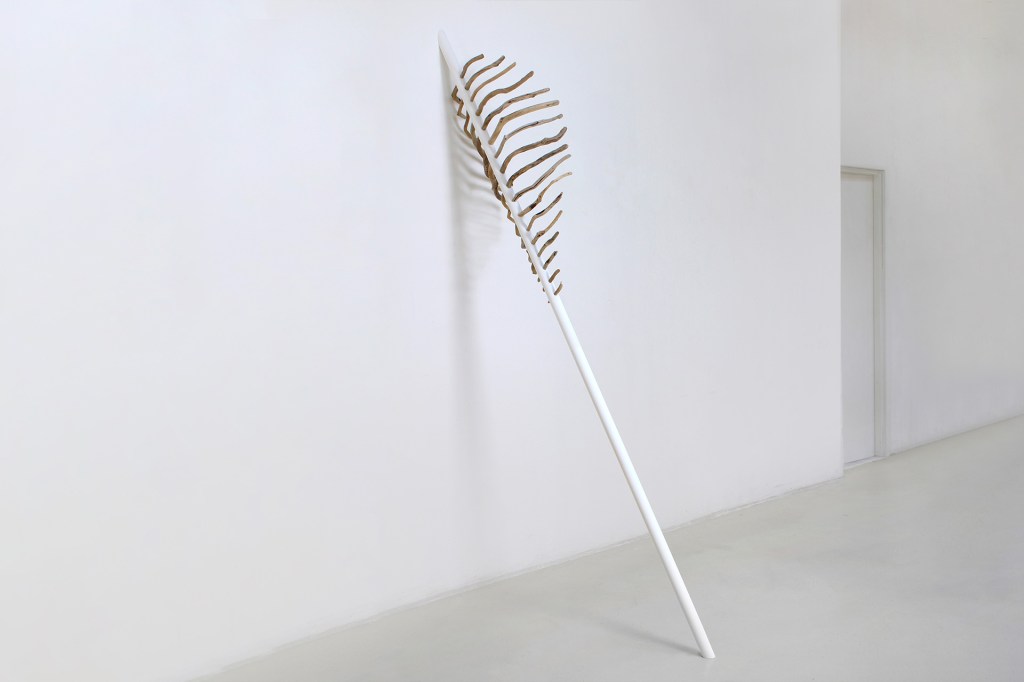
G. Longo: They do it in so many ways. There is an innate aspect in the structures which seem slender, delicate and fragile in appearance; complete or incomplete anatomies reveal fractures, voids and concavities, thus letting themselves be run through by the space around them without resistance. Then there is the context that affects the colour of the surfaces, dimensions, perspective and correlation with the viewer. Exhibiting these works in a neutral place, within an archaeological park or nature, will undoubtedly have different outcomes. And, ultimately, the relationship between these two aspects, thus the presence of one in each other. So, slender wooden pieces emulate tails through conical protrusions of the wall (Threesome, 2020), a backbone is functional to curve and hook two tubular elements arising from soil (Morph, 2021) or a rod with ribs props up a wall, sinking in it, leaving one in doubt as who the actual support is (Collapse, 2022).
Mine is a sculpture I would call light, upheld by what lies around the conquering of a stable centre of gravity, physical yet aesthetic and even ideal.
G. Landi: Are you interested in the poetic dimension of the work?
G. Longo: Every artist pretty much meets this dimension. I believe it is best to develop naturally from itself than through impositions. That’s why it is necessary to descend vertically into one’s artistic practice and recursive gestures to understand one’s profound motivations. That does not prevent us from letting the outside influence us, but it probably helps us read it personally, free of easy shortcuts or tired rhetoric.
G. Landi: How do you proceed in your work? Do the materials suggest what to do or do you start from a pre-determined idea?
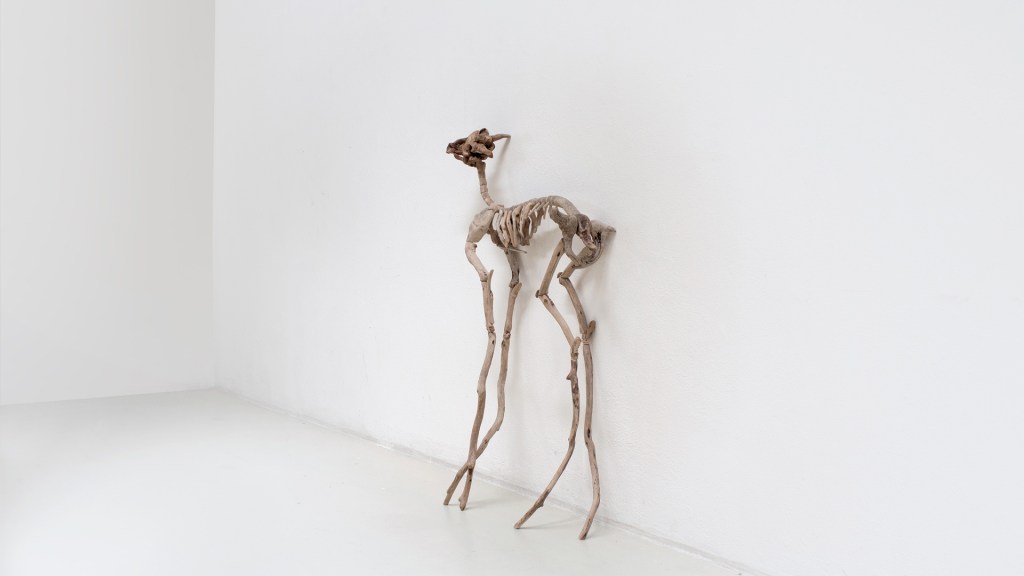
G. Longo: I usually start from a project and then retrieve what I need. Skeletons are evolutionary identity cards. Each class carries a heritage adjusted for a million years. Just think of the differences between birds, amphibians or mammals. It is their anatomies that have adapted for survival. I find this fascinating and, since the beginning of my research, I heavily took up an interest in conditions mutated by necessity. The analogy with these drifting roots and branches, the so-called driftwood, was immediate and allowed me to transfer other memories, such as that of a territory, a landscape or an identity, to create a single element.
G. Landi: In the same vein, have you ever taken an interest in landscape?
G. Longo: Landscape is a set of natural ecosystems, anthropological and spatial correlations: it is around us but also within us, inside living beings that animate it and things that constitute it. I believe that in my work this relationship is intrinsic although still explorable.
In 2016, I held a solo exhibition titled Fragile Landscapes (MARCA Museo delle Arti di Catanzaro, catalogue Rubbettino Editore) starting precisely from this concept of a fluid and delicate nature. The main body of the exhibition was made up of skeletons, but there were also multidisciplinary experiences such as large financial diagrams that became colourful landscapes, or the video document of the destruction of the Buddhas of Bamiyan in Afghanistan, reshaped by leaving the seconds before and immediately after the detonation.
Reflecting in retrospect, I realised that I had always worked with a very similar method regardless of the medium: archiving forms, data and information to take them beyond certain boundaries, outcoming a new physicality and also a new landscape to the material collected.
G. Landi: How do you proceed in collecting the material you use and what criteria do you use?
G. Longo: Over time, I perfected and improved this step and, gradually, built up an archive that allows me to not go on site every time.
Starting from the river’s mouth, I focus on the best-kept materials and the shapes I am looking for. Sometimes I prefer to collect harder woods such as olive and pine, and other times lighter shrubs such as oleander and its roots. Although at first glance one would not think so, the range of colours is quite wide and becomes an integral part of the choice. One can see yellowish surfaces or more neutral tones, or dark residues of the barks tattooed on worn-out wood. All this requires deep observation, which is completed in the studio where I classify wood by shape and size: some will be a “Shoulder-blade S” because of its small triangular shape, others a “Rib L” if it has a wide curvature.
I realise that this may sound slightly insane, and indeed it is, but it is necessary to enter into symbiosis with this natural flow and speed up the process of comparison, allowing me to easily identify elements that are useful in establishing the whole of a certain work.
G. Landi: How do you work in studio?
G. Longo: After accumulating and classifying the materials, this archive becomes one of the working tools. I can consult it and find pieces that will be hooked through various types of joints, depending on whether they are going to be fixed or semi-fixed. The work can also be completed while waiting to find the most suitable parts, which can take several months.
I must say, however, that my conception of the studio, precisely in light of this wait, has expanded quite a bit. Besides the physical place where things materialise, the studio is for me a state of perpetual alertness, aimed at the compulsive accumulation of scientific information, technological, philosophical and social suggestions that, once sedimented, will interact with the matter by following mysterious paths and continuously producing entirely theoretical work.
G. Landi: Does the playfulness of it holds any importance in your work?
G. Longo: I like to think that art is all a game, and I try to preserve that playful vision and continuous discovery typical of children. It’s not always easy. Art is also confronting a restlessness, a sweet agony that leads you towards other paths.
 Giovanni Longo